
१३ साउन २०८३ , बुधबार | July 29, 2026 Wednesday
Published At: 2026-01-07 11:27 PM
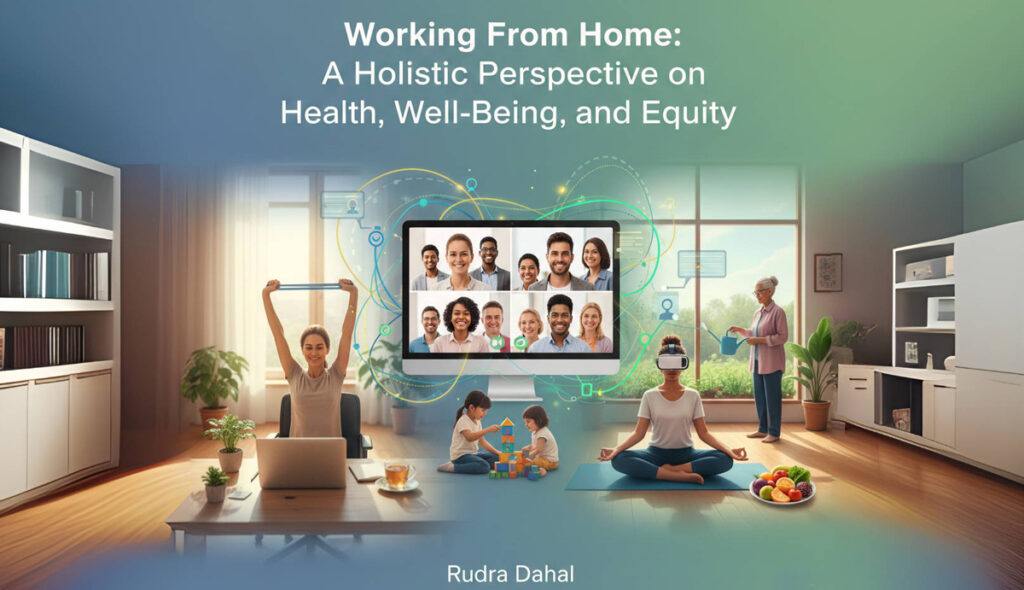
The rapid expansion of working from home (WFH) represents one of the most significant transformations in the global circle of work in recent decades. Accelerated by the COVID-19 pandemic but sustained by digital revolution, WFH has shifted work from centralized offices to private homes across globe. While much of the public discourse has focused on productivity, efficiency, and organizational cost savings, the implications of WFH for health and well-being deserve deeper analytical attention. From physical and mental health outcomes to social connection, gender equity, and structural inequality, WFH presents a complex mix of benefits and risks that vary across countries, occupations, and social contexts.
From a health perspective, one of the most widely reported benefits of WFH is the reduction in commuting-related stress. In major global cities such as Toronto, London, New York, Tokyo, and Mumbai, long daily commutes have long been associated with fatigue, anxiety, reduced sleep, and lower life satisfaction. By eliminating or reducing commuting time, WFH has enabled workers to reclaim time for rest, family interaction, physical activity, and self-care. In high-income countries such as Canada, Germany, and Australia, surveys consistently show that remote workers report higher satisfaction with work–life balance than they did before the pandemic. This improvement is particularly evident among caregivers, parents of young children, and individuals with disabilities, for whom flexible work arrangements can reduce physical strain and logistical challenges, contributing positively to overall well-being.
WFH has also reshaped mental health experiences in nuanced ways. On one hand, increased autonomy and control over work schedules can enhance psychological well-being by reducing workplace stressors such as micromanagement, noise, and frequent interruptions. Knowledge workers in sectors such as research, education, finance, and information technology especially in the United States, Western Europe, and East Asia have reported improved concentration and reduced performance anxiety when working remotely. On the other hand, the same autonomy can blur the boundaries between work and personal life. Without clear spatial and temporal separation, many workers experience extended working hours, constant digital connectivity, and difficulty disengaging from work. Evidence from Japan, South Korea, and the United States suggests that WFH has, in some cases, intensified overwork cultures rather than alleviating them, contributing to burnout, sleep disturbances, and chronic stress.
Social well-being is another significant dimension affected by WFH. Workplaces are not only sites of economic production but also important spaces for social interaction, identity formation, and emotional support. The shift to remote work has reduced informal encounters, spontaneous conversations, and opportunities for mentorship. Early-career professionals and new employees in countries such as the United Kingdom, Canada, and Nordic nations report feelings of isolation and weaker professional socialization in remote settings. While digital platforms facilitate task-oriented communication, they often fail to replicate the relational depth of in-person engagement. Over time, this social disconnection can affect motivation, job satisfaction, and mental health, particularly for individuals living alone or in small households.
Physical health outcomes associated with WFH present a similarly mixed picture. On the positive side, flexible schedules can allow workers to incorporate physical activity into their daily routines, such as walking, stretching, or home-based exercise. Reduced exposure to infectious diseases in crowded workplaces and public transportation has also been cited as a health benefit, especially during and after pandemic periods. However, prolonged sedentary behavior, poor ergonomic setups, and inadequate home workspaces pose significant risks. In many countries, particularly among lower-income households and urban renters, homes are not designed to function as long-term workplaces. Reports from both high-income and low- and middle-income countries indicate increases in musculoskeletal pain, eye strain, and headaches associated with poorly equipped home offices, highlighting how housing conditions intersect with occupational health.
The health implications of WFH are also deeply gendered. While remote work is often promoted as a way to support women’s labor force participation, its actual impact depends on social norms and household dynamics. In countries such as India, Nepal, Brazil, and parts of Southern Europe, women working from home frequently shoulder a disproportionate share of unpaid domestic labor and caregiving responsibilities. This “double burden” can negate the mental health benefits of flexibility and increase stress, exhaustion, and role conflict. Even in countries like Canada and the United States, research suggests that women working remotely often take on more childcare and household tasks than their male counterparts, particularly in the absence of affordable childcare. Thus, without supportive social policies and equitable household practices, WFH risks reinforcing rather than reducing gender-based health inequities.
From a broader global health equity perspective, WFH highlights stark structural inequalities in the labor market. The ability to work from home is largely confined to white-collar, digitally mediated occupations. Workers in healthcare, manufacturing, retail, transportation, agriculture, and community services sectors that employ a large proportion of the global workforce cannot benefit from remote work arrangements. This divide is particularly pronounced in low- and middle-income countries, where informal employment dominates, and digital infrastructure is uneven. While professionals in cities such as Bangalore, Nairobi, or Kathmandu may access global remote work opportunities, the majority of workers in these contexts remain excluded from the health and well-being benefits associated with WFH. As a result, WFH can unintentionally widen existing social and health disparities between occupational groups and regions.
Environmental health considerations further complicate the picture. Reduced commuting during periods of widespread remote work has been associated with lower air pollution levels in cities such as Delhi, Milan, Los Angeles, and Beijing. Cleaner air contributes to improved respiratory and cardiovascular health at the population level, reinforcing the public health potential of WFH as part of sustainable urban planning. Countries such as the Netherlands and Sweden have begun integrating remote work into broader climate and health strategies. However, these benefits may be offset by increased residential energy consumption and unequal access to energy-efficient housing, underscoring the need for integrated policy approaches.
Policy responses play a crucial role in shaping WFH-related health outcomes. Several European countries, including France, Spain, and Ireland, have introduced or strengthened the “right to disconnect,” recognizing the mental health risks of constant digital availability. Occupational health guidelines addressing ergonomics, working hours, and psychosocial risks are increasingly being adapted to remote work contexts. In contrast, in countries where labor protections are weaker or enforcement is limited, remote workers may face heightened precarity, inadequate health support, and increased self-exploitation. This variation illustrates that WFH is neither inherently health-promoting nor inherently harmful; its effects depend on governance, institutional support, and organizational culture.
In analytical terms, WFH should be understood as a social determinant of health rather than merely a work arrangement. It shapes daily routines, social interactions, physical environments, and access to resources, all of which influence health outcomes. The growing shift toward hybrid models in countries such as Canada, the Kingdom, Japan, and Australia reflects an attempt to balance flexibility with social connection and occupational health. Hybrid work allows employees to benefit from reduced commuting and autonomy while maintaining opportunities for collaboration, mentorship, and collective identity, potentially offering a more sustainable pathway for well-being.
In conclusion, working from home represents a profound transformation in how work, health, and well-being intersect globally. Its benefits reduced stress, improved work–life balance, and greater flexibility are substantial but unevenly distributed. At the same time, risks related to mental health, social isolation, physical strain, and inequality demand careful attention. Viewing WFH through a health and well-being lens reveals that its long-term success depends not only on technology, but also on inclusive policies, supportive social systems, and a commitment to equity. As the future of work continues to evolve, integrating health considerations into remote and hybrid work models will be essential for creating a more sustainable, humane, and just global labor system.
………………………………………………………………………………………………………
Disclaimer: This article represents the author’s personal perspectives and does not reflect the views or positions of any affiliated institution.
© 2026 All right reserved to usnepaltoday.com | Site By : SobizTrend