५ असोज २०८३ , सोमबार | September 21, 2026 Monday
Published At: 2026-05-24 12:25 AM
A recent image circulating widely on social media has deeply disturbed many Nepalis. In the photograph, a uniformed official appears to force a street vendor to dump her basket of fruits (bayberry) onto the road while she stands nearby in visible distress. For many viewers, the image is more than a routine act of enforcement—it represents a painful question about dignity, governance, and the treatment of vulnerable citizens in Nepal.
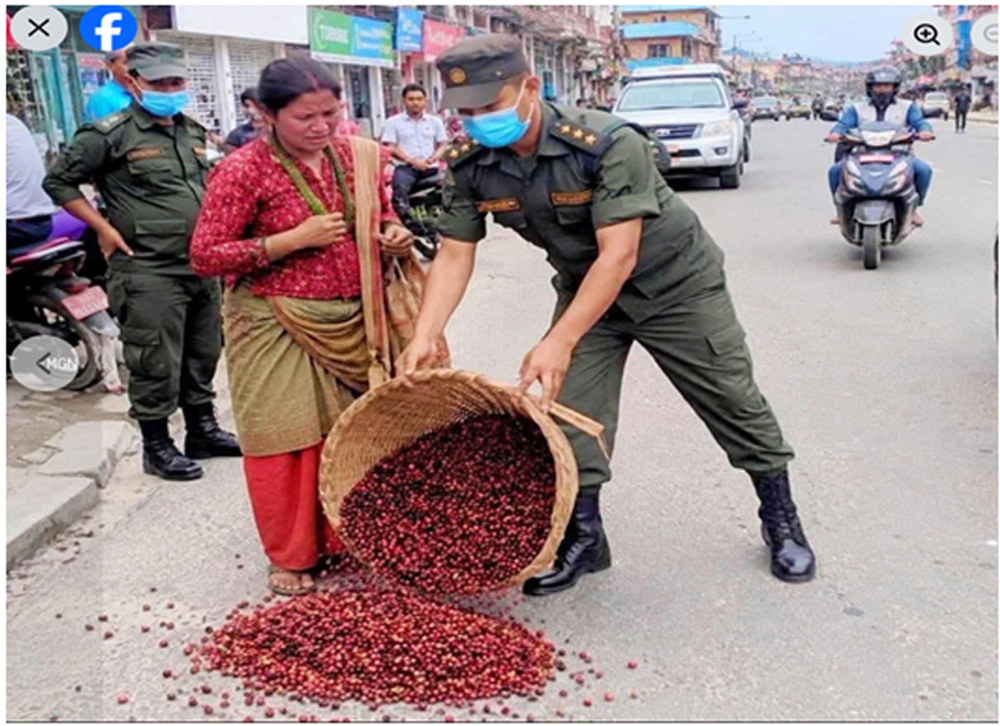
Image Source: Facebook
Good governance is not measured only by how effectively rules are enforced. It is also measured by the degree of humanity with which power is exercised. When enforcement actions publicly humiliate poor citizens, particularly those already struggling to survive, the state risks appearing disconnected from the realities of ordinary people. Images such as this evoke strong emotional reactions because they reflect a visible imbalance of power: a vulnerable street vendor losing her goods in front of authorities and the public. Even if officials were acting within legal authority, the method itself raises ethical and governance concerns.
Street vendors in Nepal are often part of the informal economy, a sector that supports thousands of families. Many vendors are women, elderly individuals, migrants from rural areas, or people with limited education and employment opportunities. For them, daily street vending is not simply a business choice—it is often the only available source of income. A basket of fruits or vegetables may represent an entire day’s investment, borrowed money, or the only means to feed a family. When such goods are destroyed or confiscated without compassion, the consequences extend far beyond temporary financial loss.
The emotional and psychological impact of public humiliation is also significant. Poverty already places enormous stress on individuals and families. When people are treated harshly in public spaces, feelings of shame, fear, helplessness, and anger can intensify. Such experiences may damage trust in institutions and contribute to growing frustration toward authorities. In societies where social dignity and public respect hold deep cultural importance, humiliation can leave lasting emotional wounds.
This issue is particularly important in a country like Nepal, where economic inequality, unemployment, and migration continue to affect large segments of the population. Many young people leave Nepal for foreign employment because they struggle to find opportunities at home. Those who remain often survive through small, informal work. In such a context, punitive approaches toward street vendors may appear less like governance and more like punishment of poverty itself.
International expériences provide important lessons. In several countries, local governments have shifted away from purely punitive approaches and adopted more inclusive urban management strategies. In India, some cities have introduced designated vending zones where street vendors can legally operate under regulated conditions. Thailand and Indonesia have implemented systems that combine licensing, sanitation rules, and designated market hours while still protecting vendors’ livelihoods. In parts of Latin America, local authorities collaborate with vendor associations to develop fair and practical regulations rather than relying solely on confiscation and force.
These approaches recognize an important principle: informal workers are not enemies of development. They are citizens trying to survive within difficult economic conditions. Effective governance, therefore, requires balancing public order with social justice and compassion.
Nepal’s local governments have an opportunity to rethink how enforcement is carried out. First, authorities should prioritize respectful communication before taking punitive action. Many conflicts escalate because citizens feel unheard or disrespected. Training municipal police and enforcement officials in conflict resolution and human rights-based approaches could help reduce confrontational situations.
Second, municipalities should create designated vending spaces wherever possible. Completely removing vendors without providing alternatives only shifts the problem elsewhere. Organized vending areas, proper waste management systems, and affordable licensing structures could help cities remain orderly while protecting livelihoods.
Third, there must be greater transparency and consistency in enforcement. Public frustration often increases when rules appear selective or politically influenced. Citizens are more likely to respect regulations when they believe enforcement is fair and impartial.
Fourth, local governments should recognize the mental health and social consequences of public humiliation. Poverty is not only an economic condition—it also affects confidence, dignity, and emotional well-being. Public policies should therefore avoid approaches that unnecessarily shame vulnerable populations.
Media and social media also play an important role. While images like this can raise awareness, they can also deepen public anger and polarization if discussions become overly emotional or one-sided. Constructive public dialogue should focus not only on blame but also on solutions.
At its core, this issue reflects a broader challenge facing Nepal’s democracy and governance system. Citizens expect development, order, and modernization, but they also expect empathy and fairness. A government that appears efficient but insensitive risks losing public trust. Conversely, a system that ignores regulations entirely also creates disorder and inequality. The real challenge lies in finding balance.
Good governance is not demonstrated solely through fear. It is demonstrated when laws are enforced with wisdom, proportionality, and humanity. A poor street vendor should not have to lose their dignity for a city to maintain order. Development should uplift citizens, not deepen their suffering.
Ultimately, the image that is circulated on social media should serve as an opportunity for reflection—not only for authorities, but for society as a whole. Nepal must ask itself an important question: what kind of governance does it want to build? One based primarily on punishment and power, or one guided by fairness, dignity, and compassion?
The answer to that question will shape not only the future of Nepal’s cities, but also the relationship between the state and its people.
……………………………………………………………………………………………………….
Disclaimer:This article represents the author’s personal perspective and does not reflect the views or positions of any affiliated institution.
© 2026 All right reserved to usnepaltoday.com | Site By : SobizTrend